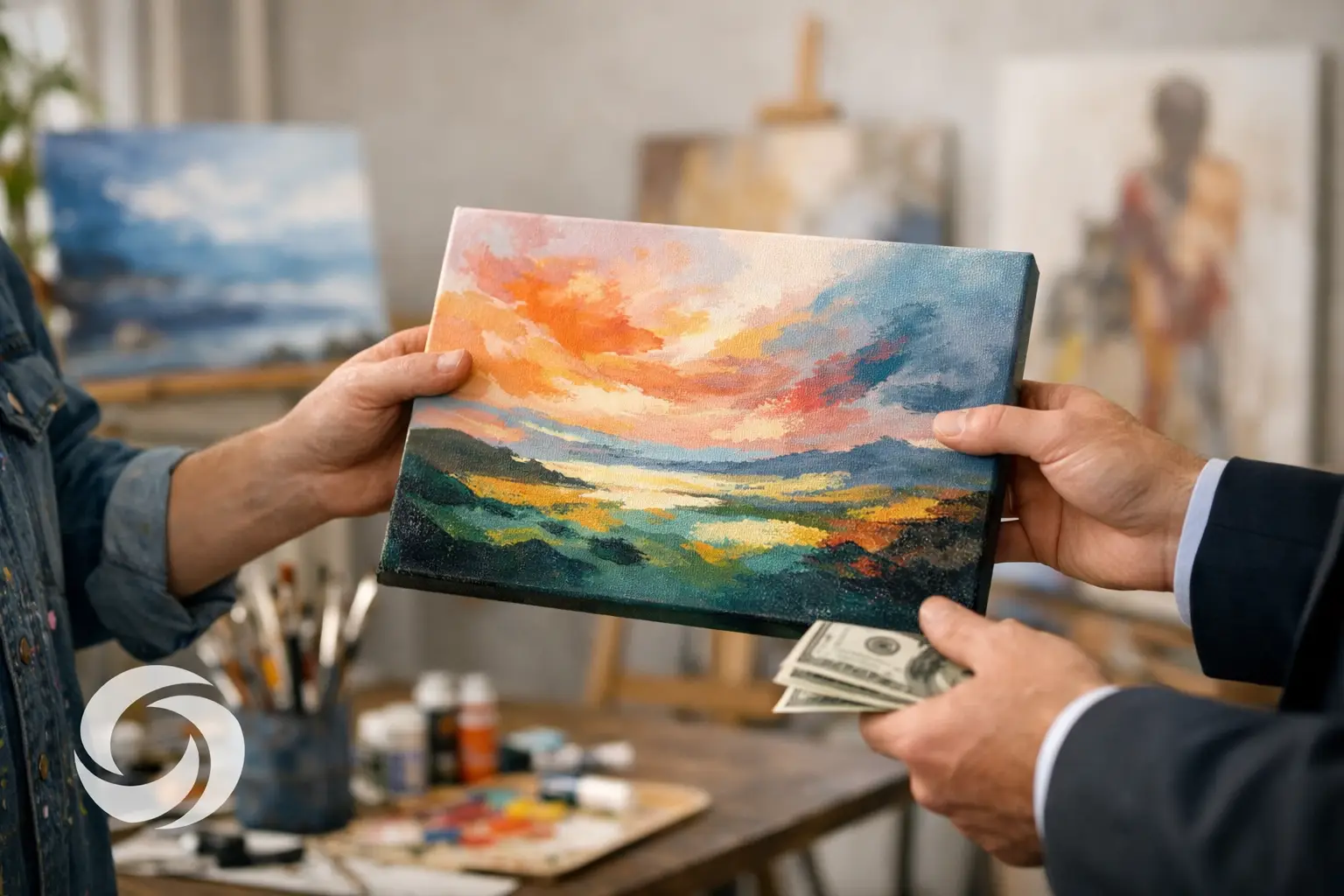
A lot can happen between an artist finishing a piece and that work landing on your wall. Prices shift. Context gets flattened. The story behind the work can disappear entirely. When you buy art directly from artists, that distance shrinks. What you get instead is something more personal, more transparent, and often more rewarding than people expect.
For many buyers, especially those just starting to collect, the idea of purchasing original art can feel more intimidating than it should. There is still a lingering myth that buying art is reserved for insiders who already know the right names, the right terms, and the right price ranges. But the truth is simpler. If you love living with original work, want to support working creatives, and care where your money goes, buying directly from artists is one of the best ways to begin.
Why buy art directly from artists?
The biggest reason is connection. You are not just choosing an object that matches a sofa or fills an empty wall. You are choosing a piece of someone’s practice, process, and point of view. That changes the experience.
When artists sell their own work, they can tell you what inspired the piece, how it was made, what materials were used, and where it fits in their broader body of work. That context matters. It often becomes part of why a piece stays meaningful long after you bring it home.
There is also a practical side. Buying directly can create clearer pricing because fewer layers sit between maker and buyer. That does not always mean cheaper. Strong work is still worth paying for, and experienced artists price with intention. But it often means the price reflects the work more honestly, without confusion around markup, resale assumptions, or vague prestige.
For artists, direct sales matter in a real way. They support studio practice, materials, time, and the ability to keep making new work. If you care about local culture, this is one of the most immediate ways to invest in it.
What makes direct buying feel different
The difference is not just financial. It is emotional.
When you meet an artist in person, visit a studio, or speak with them during an exhibition, the work stops feeling distant. You begin to notice details you might have missed online or in a more transactional setting. Texture becomes more visible. Scale makes more sense. A quiet piece may hold your attention longer than something louder at first glance.
That is one reason open studios and exhibition spaces feel so valuable. They let buyers encounter art in a human setting rather than in a stripped-down product grid. You can ask questions without feeling rushed. You can compare pieces in real life. You can take your time and figure out what actually resonates.
For first-time buyers, this often removes the pressure. You do not need a collector vocabulary to know when a piece feels right. You just need the chance to look closely and ask honest questions.
Buy art directly from artists and get clarity on value
Original art pricing can seem mysterious from the outside, but it is usually built from understandable factors. Size matters. Materials matter. An artist’s experience matters. So do exhibition history, technical complexity, and the amount of labor behind the work.
Buying direct gives you a clearer view of those factors. You can ask how a work was built, how long it took, whether it is part of a series, and what makes it distinct from other pieces. That kind of conversation helps buyers feel more confident because value becomes less abstract.
There are trade-offs, of course. Some buyers prefer a more guided setting where a gallery team helps narrow options, explain the market, or frame the artist’s career in broader context. That can be extremely helpful, especially for established collectors building with specific goals in mind. Direct buying is not better in every scenario. It is better when you want immediacy, conversation, and a more personal relationship to the work.
In the strongest art communities, these experiences work together. Artists, galleries, and studio spaces all play a role in helping people discover and collect with confidence.
How to know what to ask before you purchase
You do not need to interrogate the artist, but a good conversation can help you make a smart decision. Ask about medium, dimensions, framing, installation needs, and care. If it is a work on paper, you may want to know whether it should be kept out of direct sun. If it is mixed media, ask whether the surface is delicate. If it is part of a larger series, ask what the artist was exploring.
You can also ask about commissions, payment options, or whether similar works are available. Many artists are open to these conversations, and approachable spaces make them easier. The point is not to sound like an expert. The point is to understand what you are bringing into your home or collection.
A useful question is also the simplest one: What keeps you returning to this piece? Sometimes your answer will be visual. Sometimes it will be emotional. Either is valid.
Why local art scenes make direct buying even better
Buying local adds another layer of meaning. You are not only supporting an individual artist. You are helping sustain the creative life of your own city.
That matters in a place like Houston, where artists are producing ambitious, original work across painting, sculpture, photography, mixed media, and more. Seeing that work in person, often where it is made, gives buyers a richer sense of the city’s creative energy. It also turns collecting into an experience rather than a transaction.
That is part of what makes studio hubs and public exhibitions so compelling. You can discover artists at different stages of their careers, talk with them directly, and find work that feels connected to place. For many buyers, that local connection becomes part of the artwork’s long-term value. It reminds them of a specific neighborhood, conversation, event, or season in their life.
In spaces like Art Machine Gallery, that access feels especially approachable because the environment invites curiosity. You can come in as a serious collector, a weekend browser, or someone buying their first original piece. The point is not to perform expertise. The point is to have a real encounter with art and the people making it.
Common concerns people have before buying direct
One common worry is whether buying directly is somehow less legitimate than buying through a traditional gallery. It is not. What matters is that the work is original, the pricing is clear, and the artist or venue presents it professionally.
Another concern is whether a buyer might make the wrong choice. That depends on what you mean by wrong. If you are buying purely as an investment, you may want more market research and professional guidance. If you are buying because you want to live with art that moves you, the decision is often much more intuitive.
People also worry about not knowing enough. But collecting does not start with expertise. It starts with attention. The more work you see, the more your eye develops. The more artists you meet, the more comfortable you become asking questions and recognizing what you respond to.
And yes, budget matters. The good news is that buying directly often opens up a wider range of price points than people expect. Not every original artwork is out of reach. Many artists create pieces at different scales and price levels, which makes collecting more accessible for new buyers.
The real reason this way of buying lasts
Trends come and go. Certain colors dominate interiors for a year, then vanish. But art bought through genuine connection tends to stay with people. It keeps its place because it was never just decor.
When you buy art directly from artists, you remember where you found it. You remember the conversation. You remember why that piece stood out among dozens of others. That memory becomes part of the work’s life in your home.
If you are thinking about buying original art, start there. Look in person when you can. Ask questions. Trust your response, but learn as you go. The best collections are not built by chasing intimidation or status. They are built piece by piece, through curiosity, connection, and a willingness to bring real creative work into everyday life.
