
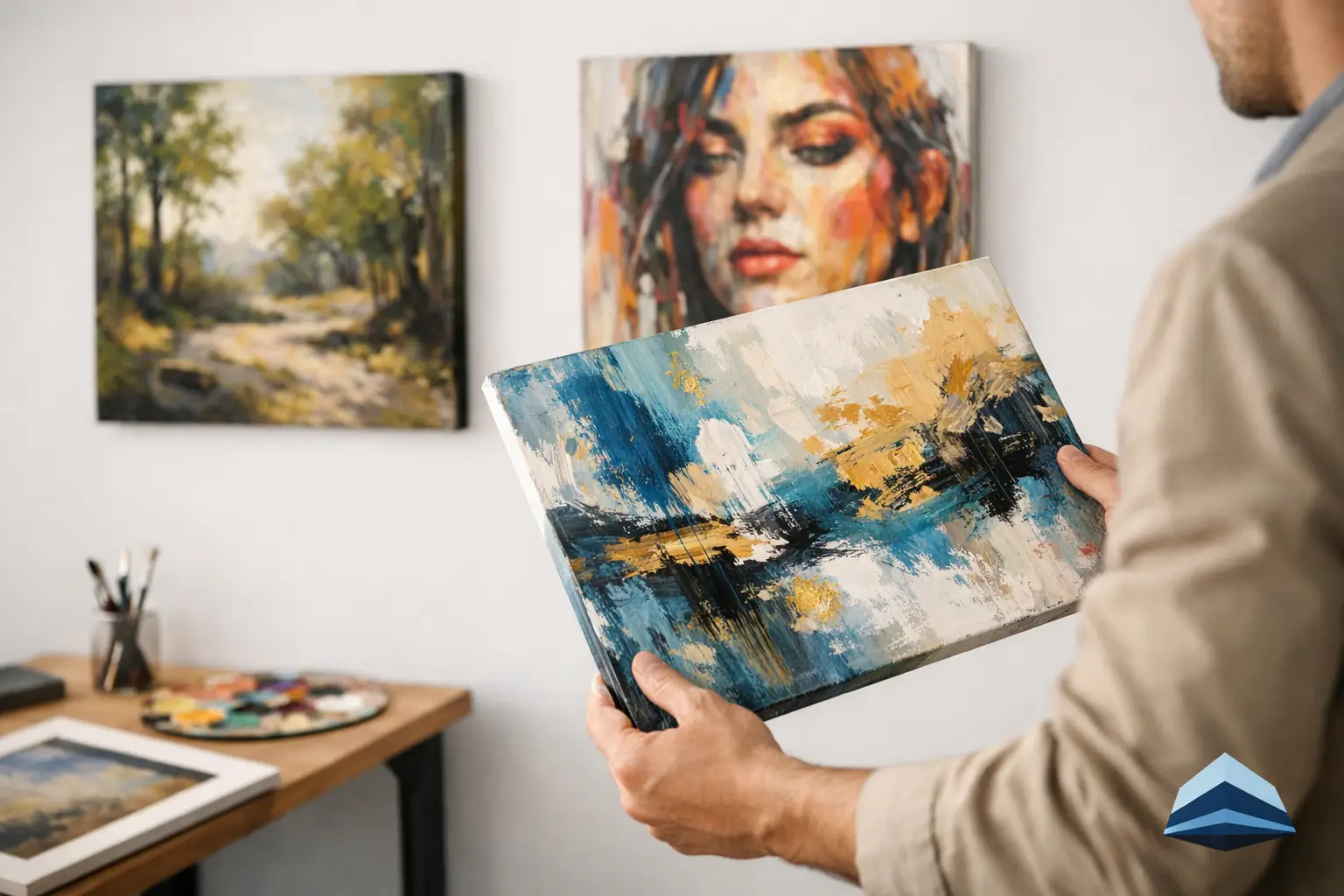
A blank wall can make a room feel unfinished, but the wrong artwork can feel even worse – expensive, impersonal, and easy to second-guess. A good guide to buying original paintings should do more than tell you to trust your taste. It should help you understand what you are looking at, what you are paying for, and how to buy with real confidence.
Original paintings carry something prints and mass-produced decor usually do not: presence. You notice the brushwork, the surface, the decisions the artist made by hand. That does not mean every original painting is right for every buyer. It means the process should be personal, a little thoughtful, and grounded in what you actually want to live with.
Why a guide to buying original paintings matters
People often assume buying original art is only for seasoned collectors or people with very large budgets. In reality, many first-time buyers enter the market through local galleries, studio visits, and community art spaces where the experience is much more approachable than they expected.
The bigger challenge is not access. It is knowing how to judge fit. A painting can be beautiful and still be wrong for your space, your budget, or the way you want to collect. Some buyers want one standout piece for a dining room. Others want to begin building a collection around local artists, a certain medium, or a personal connection to place. Those are different goals, and they lead to different decisions.
Start with how you want the painting to feel
Before you think about price, size, or investment value, think about the role the artwork will play in your life. Do you want a painting that anchors a room and starts conversations? Do you want something quieter that rewards attention over time? Are you drawn to bold contemporary work, atmospheric landscapes, expressive portraits, or abstract compositions with strong color relationships?
This is where buyers often overcomplicate things. You do not need perfect art vocabulary to know when a piece keeps pulling you back. If you return to the same painting more than once, that matters. If you can already picture how it changes the mood of a room, that matters too.
At the same time, emotional response should not be your only filter. A painting you love in a gallery may feel different in your home if the scale is off or the colors compete with everything around it. Taste is the starting point. Practical fit is what helps the decision hold up after the excitement of the purchase.
Set a budget, but keep it flexible
A practical guide to buying original paintings has to talk about budget without making art feel transactional. Price in original art reflects more than materials. It can also reflect the artist’s experience, exhibition history, size, complexity, demand, and the context in which the work is being sold.
That means two paintings of the same size may be priced very differently, and that is not automatically a red flag. An emerging artist may offer exceptional value, while a more established artist may command higher prices because of career momentum and collector demand.
Set a range instead of one rigid number. If your budget is $1,000, maybe your workable range is $800 to $1,300 for the right piece. That gives you room to respond to a painting that feels genuinely special. It also helps you factor in framing, delivery, or installation if those are not included.
If you are buying your first original painting, there is no prize for stretching too far. Buy something meaningful at a level that feels comfortable. Collecting can build over time.
Look closely at the painting itself
Photos help, but original paintings are best judged in person whenever possible. Surface matters. Scale matters. So does the way color shifts under natural light.
When viewing a piece, step close and then step back. Up close, notice texture, layering, edges, and brushwork. From a distance, look at composition, balance, and whether the painting holds together. Ask yourself if the piece has depth, energy, restraint, or tension – whatever qualities you tend to respond to.
This is also the moment to notice condition. Is the canvas warped? Is the paint stable? Are there scratches, cracks, or signs of poor storage? Minor characteristics may simply be part of the artist’s process, especially in heavily textured work. Obvious damage is a different issue and should be discussed clearly before purchase.
Learn about the artist, not just the object
One of the best parts of buying original art is that you are not buying from a factory. You are buying a piece of someone’s creative practice. Knowing more about the artist often deepens your connection to the work and helps you understand the price.
You do not need a full academic biography. What helps is learning where the artist is in their career, what themes they return to, how they work, and whether the painting fits within a larger body of work. That context can tell you a lot about seriousness, consistency, and artistic direction.
For many buyers, local art has a particular pull because it ties collecting to community. Meeting artists at open studios or exhibitions makes the experience less abstract. It turns the purchase into a relationship, not just a transaction. In a city with a strong studio culture like Houston, that access can make buying original paintings feel far more welcoming than people expect.
Ask the right questions before you buy
A gallery or artist should be able to answer straightforward questions without making you feel out of place. Ask whether the work is original, whether it is signed, what medium was used, and whether a certificate of authenticity is included. You can also ask about framing, care, and whether the painting has been exhibited before.
If you are buying directly from an artist or smaller gallery, it is reasonable to ask about the story behind the piece. Not because every painting needs a dramatic backstory, but because understanding the work often helps clarify whether it belongs in your collection.
What you are listening for is clarity, not sales pressure. Good guidance should make the decision easier, not push you into a rushed yes.
Size, framing, and placement can change everything
Buyers sometimes fall in love with an image online and forget to check dimensions. Then the painting arrives and feels either tiny or overwhelming. Measure your wall. Better yet, mark the dimensions with painter’s tape before you buy.
Think about what will surround the work. A large painting can hold a room on its own. A smaller work may need more intimate placement or may work better as part of a grouping. Neither is better. It depends on your space and how you want the room to feel.
Framing also affects cost and presence. Some paintings are meant to be shown unframed, especially contemporary gallery-wrapped canvases. Others benefit from a frame that gives the image structure. Ask what the artist intended. A frame should support the work, not compete with it.
Do not buy only for investment
Original art can appreciate, but buying solely for future value usually leads people in the wrong direction. The art market is not predictable in the way many first-time buyers imagine, and not every strong painter will become a high-dollar name.
A better approach is to buy work you genuinely want to live with, while also paying attention to quality, consistency, and artist trajectory. If value grows over time, that is a welcome bonus. If it does not, you still own something that has visual and personal value every day.
That balance matters. The smartest collectors are often the ones who buy with both heart and attention.
Where to buy with confidence
Not every buying environment feels the same. Galleries offer curation, context, and a layer of trust that can be helpful, especially for newer buyers. Artist studios can offer direct connection and a stronger sense of process. Art fairs and open studio events can expose you to many styles quickly, though they can also feel fast-paced.
The best setting depends on what you need. If you want guidance, a reputable gallery is often the easiest place to ask questions and compare work thoughtfully. If you want a direct relationship with the maker, studio visits can be especially rewarding. Spaces like Art Machine Gallery help bridge both experiences by making original art accessible while keeping the connection to working local artists front and center.
Let yourself take your time
Some paintings are instant yeses. Others need a second visit. Unless the work is likely to sell immediately and you already know it is right, it is fine to step away and think. Serious buying does not have to be rushed to be meaningful.
What usually lasts is not the most fashionable choice or the one that best matches a sofa. It is the painting that keeps its charge after the first impression – the one you want to see in morning light, at the end of a long day, and a year from now.
Buy the piece that gives something back every time you pass it.
