You do not need a designer budget, an art history degree, or a perfectly styled house to start collecting. A good guide to buying local art begins somewhere much simpler – with a piece that stops you for a second and makes you want to keep looking. That instinct matters more than people think.
Buying local art is part personal taste, part practical decision, and part community investment. You are not just filling a wall. You are bringing home original work with a real point of view, and in many cases, meeting the person who made it. For first-time buyers, that can feel refreshingly direct. For seasoned collectors, it is often what keeps collecting exciting.
Why a guide to buying local art matters
Local art gives you something mass-produced decor never can – context. The work carries the energy of a place, the perspective of a working artist, and a story you can actually tell. When guests ask about a piece, you are not saying you found it in a warehouse catalog. You are talking about an exhibition, a studio visit, or a conversation with the artist.
There is also a practical upside. Local galleries, open studios, and artist spaces often make original art more accessible than buyers expect. That does not mean every piece is inexpensive. It means there is usually a wider range of price points, mediums, and sizes than people assume when they hear the word gallery.
For a city with a strong creative ecosystem like Houston, buying local art also means participating in the cultural life of the region. You are helping artists keep making work, helping galleries keep presenting it, and helping creative districts stay active and visible.
Start with what you want the art to do
Before you talk pricing or framing, think about purpose. Are you looking for a statement piece for a living room, a smaller work for a hallway, or the beginning of a collection you want to build over time? The answer shapes everything from scale to medium to budget.
Some buyers want art that brings color and movement into a space. Others want work that feels quiet, conceptual, or emotionally layered. Neither approach is more correct. What matters is knowing whether you are shopping for a design problem, a personal connection, or both.
This is where many people overcomplicate things. You do not need to justify your taste with academic language. If a piece stays in your mind after you leave the room, that is useful information. If you like it but cannot imagine living with it, that is useful too.
Set a budget without boxing yourself in
A budget is helpful, but it should be a range rather than a hard emotional cutoff. Original art pricing reflects materials, scale, labor, experience, and demand. A small work on paper by an emerging artist may be very attainable, while a large finished painting by an established artist will naturally sit higher.
The mistake first-time buyers make is assuming original art is either cheap enough to buy casually or so expensive it is out of reach. In reality, it is a spectrum. Going in with a target range helps you have better conversations and keeps you focused, but leave room for a piece that surprises you.
If you are furnishing a whole home, it may make sense to mix levels. You might invest more in one anchor piece for a main room and choose smaller works for secondary spaces. That approach often feels more personal than trying to make every purchase perform the same job.
Where to buy local art with confidence
The best places to start are galleries, curated exhibitions, open studio events, and artist-run spaces. Each setting gives you a different kind of access.
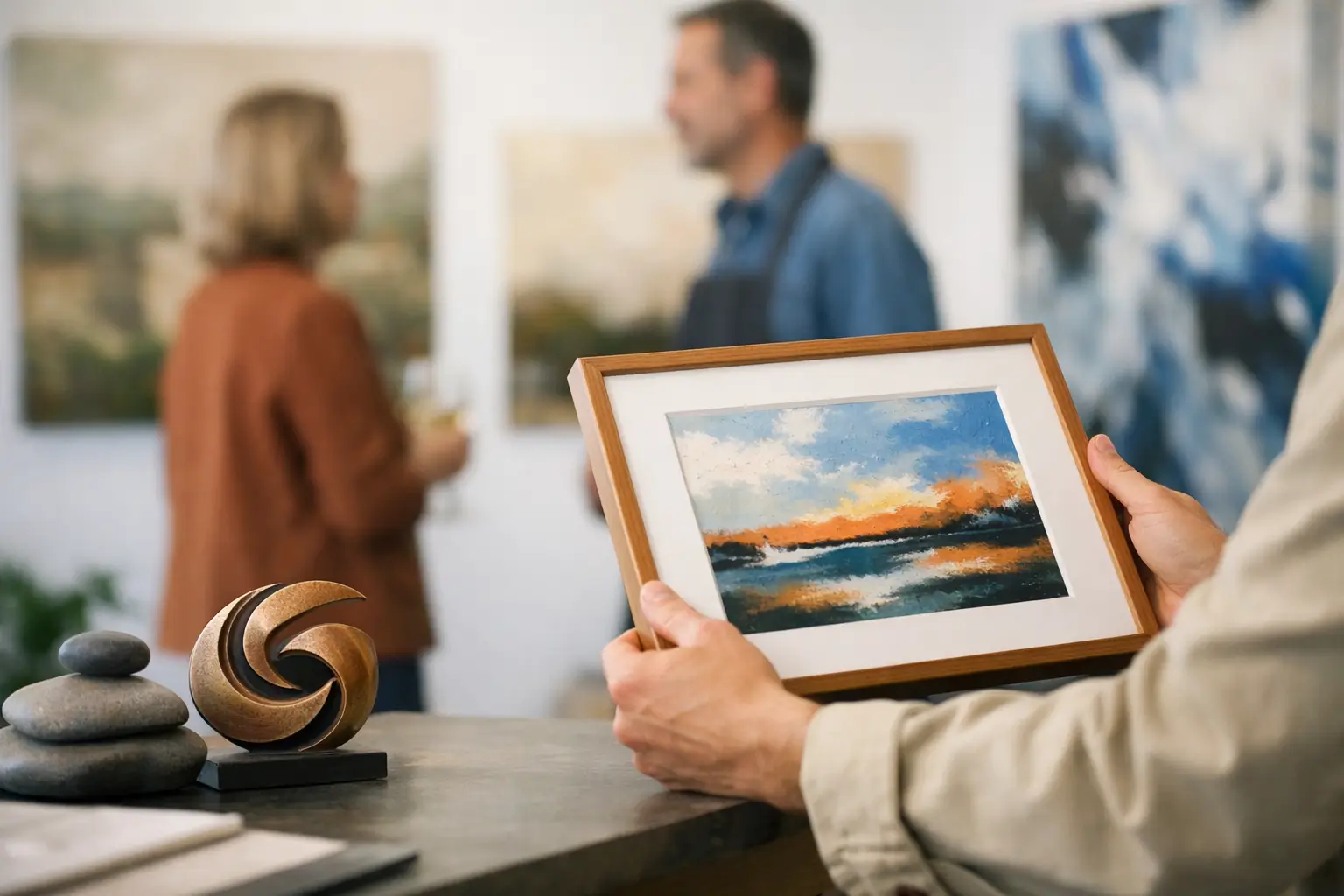
A gallery offers curation, context, and a level of guidance that can be especially helpful if you are still learning what you like. Exhibitions let you see how a body of work hangs together and how artists are being presented professionally. Open studios give you a more direct look at process, materials, and personality. That can be a huge advantage if you value connection as much as the finished piece.
In Houston, spaces inside creative hubs like Sawyer Yards make this especially easy because you can experience multiple artists and studios in one visit. Places like Art Machine Gallery help remove some of the stiffness people expect from art buying and replace it with conversation, discovery, and real local perspective.
What to look for when you are standing in front of the work
A practical guide to buying local art should tell you this clearly: slow down. People often decide too quickly that a piece is either “for them” or not. Spend a little time with it.
Look at the surface, the scale, and the way the work changes as you move. Ask yourself if the piece still feels strong after the first impression wears off. Notice whether the materials feel intentional. In paintings, that may be the layering, mark-making, or color relationships. In photography, it may be composition and print quality. In sculpture, it may be balance, finish, and presence in space.
Also think about placement honestly. A work can be beautiful and still wrong for your home. Oversized work can overpower a small room. Delicate work can disappear on a busy wall. That does not mean you should only buy to match the sofa, but the piece should have room to be seen.
Ask questions – good galleries expect it
One of the easiest ways to become a more confident buyer is to ask a few straightforward questions. What is the medium? When was it made? Is it framed? Is this part of a larger series? Has the artist shown this kind of work before?
You can also ask about care, installation, and whether a certificate of authenticity or signed documentation comes with the piece. None of this makes you look inexperienced. It makes you look engaged.
If you are buying directly from an artist or through a gallery, you should feel comfortable asking about price as well. Transparent pricing matters. So does clarity around pickup, delivery, framing, and any payment options that may be available.
Buy what you want to live with, not what you think you should buy
There is a difference between collecting strategically and collecting nervously. New buyers sometimes chase what feels safe, trendy, or approved by someone else. That usually leads to work they respect more than love.
Taste evolves. That is normal. The piece you buy today does not have to predict your entire future collection. In fact, early purchases often become more meaningful because they capture what moved you at a certain point in your life.
That said, emotional response is not the only factor. It helps to pay attention to quality and consistency, especially if you plan to keep collecting. If you are deciding between two works you love equally, craftsmanship, presentation, and the strength of the artist’s larger practice can help break the tie.
Understand the trade-offs
Every art purchase involves some kind of trade-off. You may find a piece you love in the perfect style but not the perfect size. You may choose between an emerging artist with lower pricing and an established artist with a longer exhibition record. You may want original work but realize a framed work on paper fits your budget better than a large canvas.
That does not mean you are settling. It means you are making a real decision.
Collectors who buy well over time are usually not the people trying to get every variable exactly right. They are the people who learn what matters most to them and stay open to surprise. Sometimes that means buying the smaller work now and waiting for the larger one later. Sometimes it means passing on a piece you admire because it is not the right fit for your space or your budget.
Building relationships makes collecting better
One of the best parts of buying local is that it can become relational rather than transactional. When you follow an artist’s work over time, attend exhibitions, and return to studios or galleries, your understanding deepens. You begin to see how a practice develops. That makes collecting more rewarding.
It also makes future buying decisions easier. You become less intimidated, more informed, and better able to recognize what feels significant to you. Instead of shopping for wall coverage, you are building a collection of experiences, conversations, and choices that reflect your own point of view.
For many buyers, that shift is the moment art collecting starts to feel accessible. Not because everything becomes cheap or simple, but because it becomes personal.
If you are ready to start, start small if you need to. Visit a gallery. Walk through open studios. Ask questions. Let yourself be surprised by what feels right in person. The best local art purchases usually begin there – with curiosity, not pressure.
