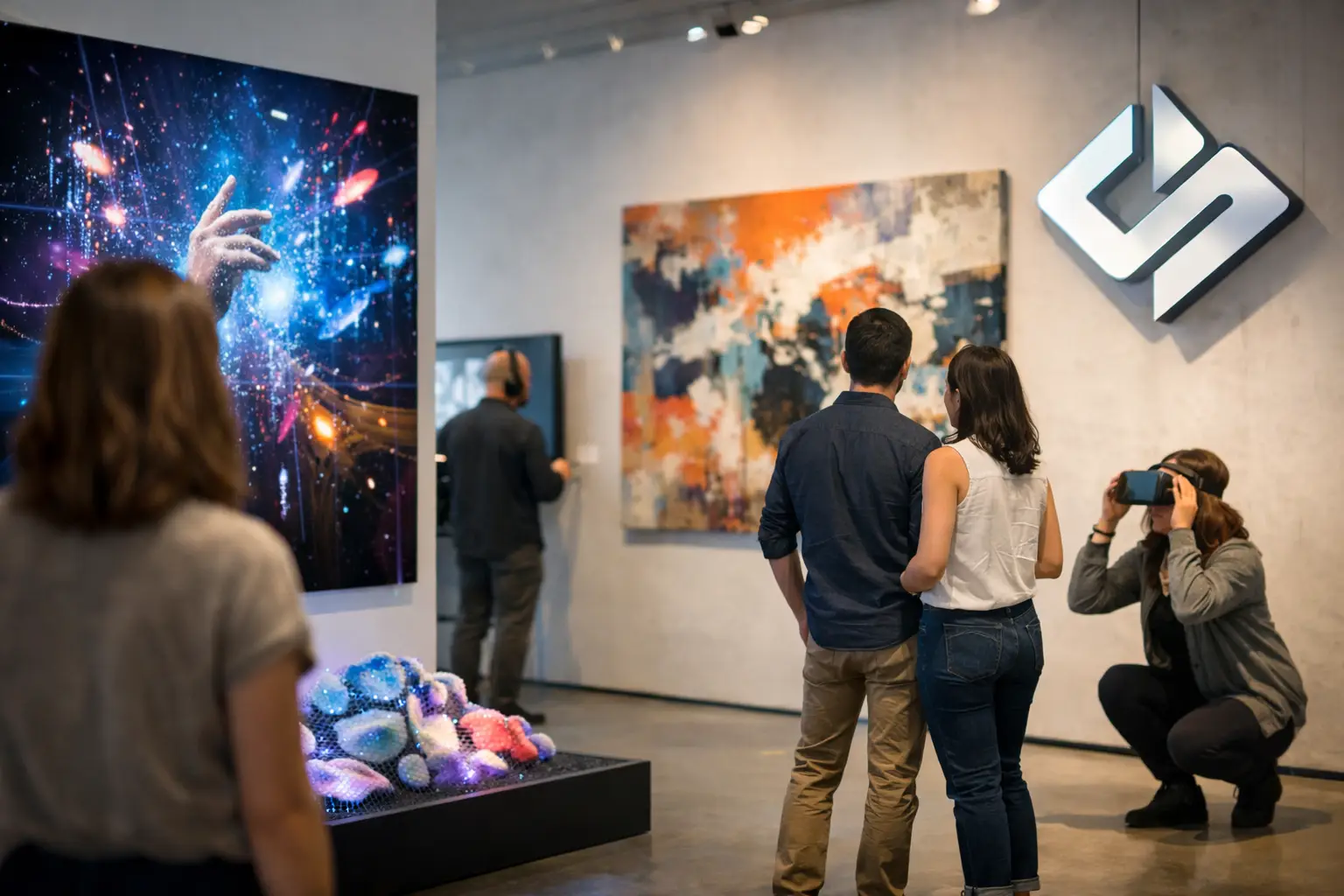
You can feel the difference almost immediately. A room full of mixed media exhibitions does not ask you to look at art in one narrow way. It asks you to slow down, notice texture, follow layers, and stay curious. One piece might combine paint and paper, another might pull in fiber, metal, photography, or reclaimed materials. The result is more than visual variety. It creates a fuller, more human experience of contemporary art.
For many visitors, that experience is part of the appeal. You do not need a formal art background to respond to a surface that looks worn, stitched, scraped, built up, or pieced together. Mixed media often meets people where they are. It can feel immediate, tactile, and emotionally direct while still carrying serious artistic depth. That balance matters, especially in gallery spaces that want to welcome both seasoned collectors and first-time buyers.
What mixed media exhibitions actually offer
At the simplest level, mixed media exhibitions feature work made with more than one material or process. That can mean collage layered with acrylic, photography combined with hand-drawn elements, sculpture built from wood and steel, or fiber integrated into painting. Sometimes the combinations are subtle. Sometimes they are bold and impossible to miss.
What makes these exhibitions compelling is not just the number of materials involved. It is the conversation between them. A rough surface beside a translucent layer creates tension. A familiar object placed inside a fine art context can shift meaning. Sewing, tearing, sanding, printing, and painting each leave their own evidence behind. Viewers are not only looking at an image. They are reading decisions, revisions, and physical effort.
That material complexity tends to make a gallery feel more dynamic. In a single visit, you might encounter works that feel architectural, intimate, playful, or deeply personal. There is room for experimentation, and that often gives the exhibition more energy than a tightly uniform presentation would.
Why mixed media exhibitions connect with more people
One reason mixed media exhibitions resonate with broad audiences is that they mirror the way people actually experience the world. Life is layered. Memory is layered. Cities are layered. So when an artist builds a work from fragments, textures, and contrasting forms, it often feels true in a way that polished simplicity does not.
That is especially relevant in a city with a strong maker culture and a wide range of artistic voices. In places where artists work across disciplines, mixed media can reflect the real character of the local scene. It makes space for painters who incorporate textile traditions, sculptors who use found industrial materials, and artists whose work sits somewhere between fine art, craft, and design. Those categories matter less than the quality of the finished piece and the clarity of the artist’s vision.
For collectors, this openness can be refreshing. A mixed media work often holds attention longer because there is more to discover over time. A piece can change throughout the day as light moves across raised surfaces or metallic elements. It can reveal details slowly. That kind of staying power matters when you are choosing art to live with.
The case for texture, scale, and surprise
A strong mixed media show rewards in-person viewing. Photos can capture composition and color, but they rarely tell the whole story. Texture is one of the biggest reasons. Thick paint, stitched fabric, layered paper, scorched wood, embedded objects, and hand-worked surfaces all create a physical presence that screens flatten.
Scale matters too. A small work built from intricate materials can pull you in close. A larger piece can create almost architectural impact, especially when materials extend off the surface or cast shadows. That interplay changes how you move through the room. You are not just scanning walls. You are navigating objects, surfaces, and spatial relationships.
Surprise is part of the pleasure as well. Mixed media encourages artists to take risks, and viewers can feel that. Sometimes a material you would not expect in a gallery setting becomes the key to the work. Sometimes a piece that seems playful at first carries real emotional weight. The best exhibitions leave room for both responses.
Mixed media exhibitions and the artist’s voice
There is a misconception that using many materials automatically makes a work more experimental or less resolved. Sometimes that is true. Sometimes an artist adds materials without a strong reason, and the work feels busy instead of intentional. But when mixed media is handled well, the opposite happens. The combination of materials sharpens the artist’s voice.
Every material brings associations with it. Fabric can suggest memory, care, labor, or domestic space. Metal might introduce strength, industry, or tension. Found objects can carry personal history or cultural commentary. Layered paper may hint at archives, erasure, or reconstruction. The artist chooses from those associations carefully. The point is not to show off range for its own sake. The point is to build meaning in a way one material alone might not allow.
That is why mixed media often feels personal. You can sense the artist assembling a language that fits the subject. In some cases, the work becomes almost autobiographical through material choice. In others, it becomes social or political, using repurposed elements to speak about consumption, neighborhood change, memory, or identity.
What collectors should look for in mixed media work
If you are new to buying original art, mixed media can feel exciting and slightly harder to evaluate. That is normal. There is more going on physically, and practical questions matter.
Start with the same thing you would start with in any artwork: does the piece hold your attention? Then look more closely at how the materials are doing their job. Are they integrated into a clear visual idea, or do they feel random? Does the composition feel intentional? Is there a balance between experimentation and control?
It also helps to ask about longevity. Different materials age in different ways, and that is not necessarily a drawback. Some artists embrace change and patina as part of the work. Others use archival methods to preserve delicate surfaces. Neither approach is automatically better. It depends on the piece and the artist’s intention. What matters is understanding what you are buying and how it should be displayed or cared for.
Placement is another practical consideration. A heavily textured or dimensional piece may need more breathing room than a flat painting. Lighting can make a major difference. In the right setting, mixed media work can anchor a room beautifully because it adds depth without needing to shout.
Why these exhibitions matter for local art communities
Mixed media exhibitions do more than showcase objects. They signal that a gallery values range, experimentation, and artists who are willing to push beyond a single lane. That matters for local art ecosystems, where creative growth often happens through cross-pollination between disciplines.
An artist working near sculptors, painters, printmakers, and fiber artists is likely to absorb ideas from all of them. A gallery that reflects that exchange helps audiences see a fuller picture of the community’s talent. It also lowers barriers for visitors who may not know the vocabulary of contemporary art but know when something feels alive, skillful, and honest.
In Houston, that kind of accessibility has real value. The strongest art spaces are not the ones that make people feel they need permission to enter. They are the ones that invite questions, reward repeat visits, and give local artists room to show work with ambition. That is part of what makes a mixed media exhibition so effective in a public-facing gallery setting. It offers variety without losing depth.
At Art Machine Gallery, that spirit feels especially natural because the work is connected to a larger creative community of working artists. Visitors are not just seeing finished pieces on a wall. They are stepping into an active conversation about how art gets made, shared, and collected.
Seeing more by expecting less uniformity
There is something freeing about walking into a show and not knowing exactly what form the next piece will take. Mixed media exhibitions keep that sense of discovery intact. They remind us that contemporary art is not a single style or material category. It is a living practice shaped by hands, ideas, neighborhoods, histories, and experimentation.
For visitors, that means a richer experience. For collectors, it can mean finding work with lasting presence and personality. For artists, it creates room to speak in the materials that make the most sense for their ideas instead of fitting themselves into someone else’s expectation.
The next time a mixed media show catches your eye, give it a little extra time. Step closer. Look at the edges, the surfaces, the joins, the parts that do not smooth themselves out. That is often where the real conversation begins.
