
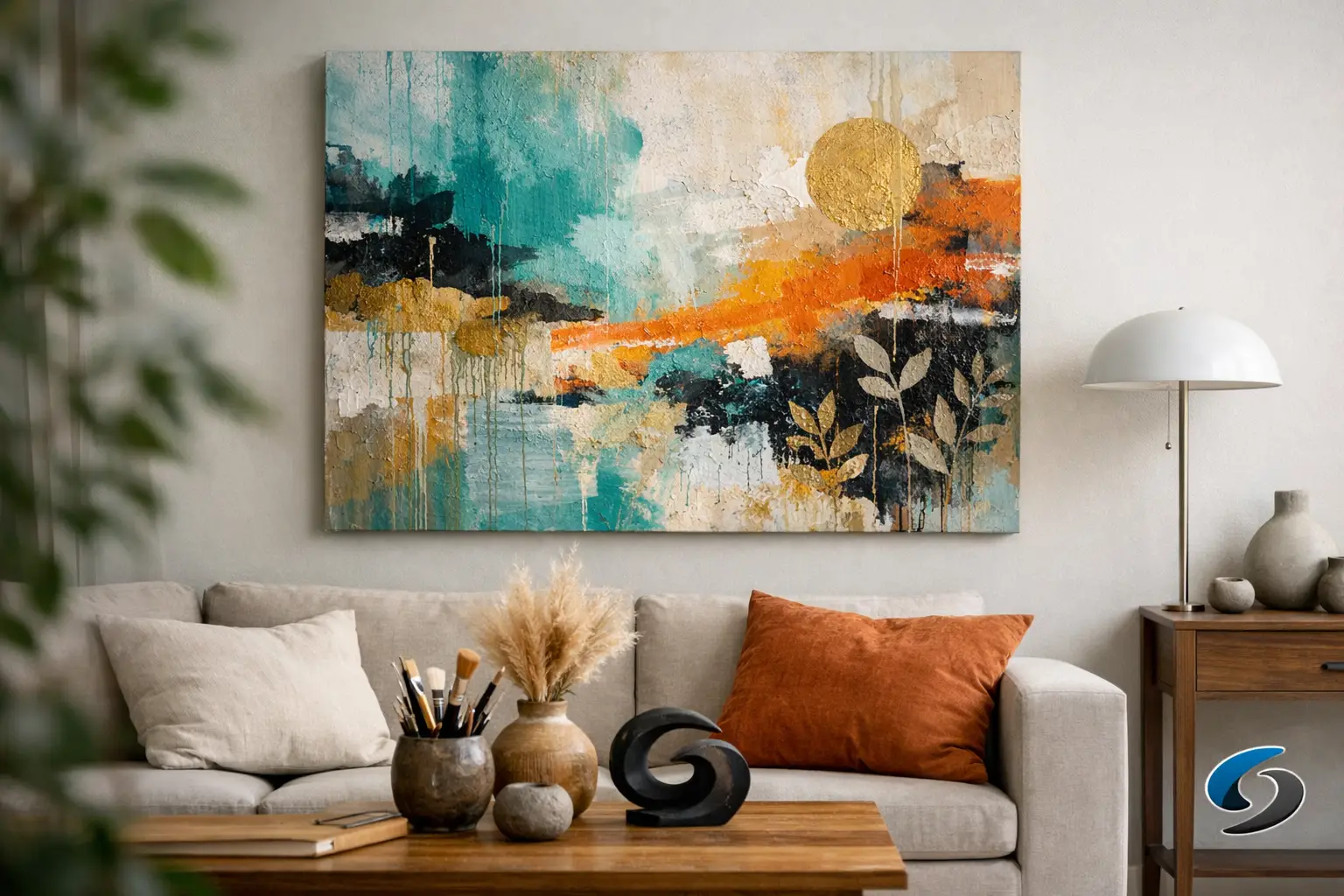
A room can have great furniture, good light, and all the right finishes and still feel a little flat. Usually, what is missing is not another chair or a bigger rug. It is tension, texture, and a sense that someone actually lives there. That is where mixed media art for interiors stands out. It brings together materials, surfaces, and gestures that make a space feel more layered, personal, and complete.
Unlike a standard framed print, mixed media work changes the way a room behaves. It catches light differently throughout the day. It adds depth to a wall without needing to shout. It can pull together colors that seemed unrelated or introduce contrast that makes everything else in the room look more intentional.
Why mixed media art for interiors works so well
Interiors are built from materials. Wood floors, stone counters, linen drapes, leather seating, plaster walls, metal fixtures. When the art in a room is only visual and not tactile in spirit, it can feel disconnected from the rest of the space. Mixed media closes that gap.
Because it may combine paint, paper, fiber, resin, found elements, charcoal, or layered collage, it speaks the same language as the room itself. That material richness gives the eye more to do. Even in a minimalist home, one textured piece can keep the design from feeling too polished or too careful.
This is also why mixed media art often feels more original in a residential setting. It does not sit on the wall like an afterthought. It participates in the design. In a living room, that might mean softening sharp architectural lines. In a dining space, it might mean adding movement and warmth. In an entry, it can set the tone before anyone notices the furniture.
What makes a piece right for your space
The best piece is not always the one that matches the sofa. Sometimes the stronger choice is the work that introduces a new material, shifts the mood, or creates a focal point the room did not know it needed.
Scale matters first. A small, intricate mixed media piece can be incredible in a narrow hallway, over a writing desk, or layered into a salon-style wall. But if you are hanging art over a large sectional or anchoring an open-plan room, undersized work tends to disappear. Mixed media has enough presence to carry larger walls well, especially when texture is part of the composition.
Color matters too, but not in the paint-chip way people often assume. A piece does not need to repeat the exact shades already in the room. It needs to relate to them. That relationship might be tonal, with soft neutrals and subtle contrast, or it might be more energetic, where one strong hue in the artwork wakes up the entire palette.
Then there is surface. If your room already includes smooth finishes like glass, polished stone, and sleek lacquer, textured art can create relief. If your interior leans rustic or heavily organic, a mixed media piece with cleaner lines or more negative space may provide balance. Good placement is often about contrast, not sameness.
How mixed media changes the mood of a room
One of the biggest reasons people respond to mixed media art is that it feels active. It carries evidence of process. Layers are built, scraped back, stitched over, or interrupted. That sense of making gives the work energy, and energy changes a room.
In calm spaces, mixed media can add just enough edge. In bold spaces, it can bring complexity so the design feels curated instead of obvious. A bedroom may benefit from softer textures, muted tones, and compositions with breathing room. A den, office, or creative workspace can usually handle more density and experimentation.
This is where personal taste should lead more than trend. Some people want art that settles a room down. Others want art that sparks conversation the second someone walks in. Both are valid. The point is to choose a piece that supports how you want the space to feel, not just how you want it to photograph.
Common mistakes when buying mixed media art for interiors
The most common mistake is treating art as the final decorative filler. If you wait until every other decision is made, you often end up looking for something that merely coordinates. Original work deserves a bigger role than that.
Another mistake is overlooking dimension. Mixed media often includes raised surfaces, irregular edges, or nontraditional framing. That is part of its appeal, but it also means placement should be thoughtful. A heavily textured piece may be perfect above a console where it can be seen up close, but less ideal in a tight passage where people brush against the wall.
Lighting is another factor people underestimate. Texture needs shadow and angle to fully register. If a piece is going in a darker room, nearby natural light or directed lighting can make a major difference. Without it, a nuanced work may lose some of the depth that made it special in the first place.
And then there is the urge to play it safe. Neutral mixed media can be beautiful, but safe is not always the same as successful. If a room already feels restrained, art is often the best place to take a risk.
Where mixed media art fits best at home
The short answer is almost anywhere, but some rooms give it extra room to shine. Entryways are a strong choice because texture creates an immediate sense of warmth and intention. Living rooms benefit from the visual weight and personality mixed media can bring to a central wall.
Dining rooms are often overlooked, yet they are ideal for art with layered detail because people spend time there at a slower pace. Bedrooms can work beautifully too, especially with pieces that have softness, subtle movement, or handmade elements that make the room feel less staged.
Home offices are another natural fit. If you spend hours in one room, flat and generic decor wears thin fast. Mixed media offers something that keeps revealing itself, which makes the space feel more human and less transactional.
Buying local adds another layer
There is something different about living with original work by an artist from your own city. The connection is more immediate. The piece is not just filling a wall. It is part of a local creative ecosystem, and that can make the experience of collecting feel far more personal.
For Houston buyers, that matters. This city has a deep bench of artists working across abstraction, collage, assemblage, painting, sculpture, and hybrid forms that do not fit neatly into one category. Seeing mixed media in person is especially valuable because photographs rarely capture texture, scale, and material nuance accurately. At Art Machine Gallery, that face-to-face experience is part of the point. You get to encounter the work as it was meant to be seen and connect more directly with the artists shaping the region’s visual culture.
How to choose with confidence
If you are new to collecting, start with response rather than rules. Which piece makes you stop? Which one keeps pulling you back across the room? That instinct matters more than memorizing design formulas.
After that, think practically. Measure the wall. Consider the viewing distance. Notice the materials already present in the room and ask whether the artwork adds needed contrast or supports an existing mood. If you are between two pieces, the better choice is usually the one with more presence, not more caution.
It also helps to give yourself permission to live with a little unpredictability. Mixed media art is not meant to be overly tidy. Its strength often comes from friction – matte against gloss, rough against smooth, order against improvisation. Those contrasts are exactly what give a space character.
A well-designed interior should not feel like every element arrived from the same page of a catalog. It should feel assembled over time, with curiosity and point of view. Mixed media helps create that feeling faster than almost any other category of art because it already contains layers, decisions, and surprises within the work itself.
If your space looks finished but still does not feel fully yours, that is worth paying attention to. The right artwork can change that. Not by overpowering the room, but by giving it texture, pulse, and a little more soul.
